China Top Traffic Cones Supplier How to Choose?
Choosing a China top traffic cones supplier requires more than comparing unit prices. It requires evidence.
The global work-zone safety market continues to expand as infrastructure investment increases. The U.S. Federal Highway Administration reported 891 work-zone fatalities in 2022. NHTSA data also confirms that roadside visibility remains a serious safety concern. These figures give traffic cones a practical role, not merely a decorative one.
Paul Carlson, a former Texas A&M Transportation Institute traffic-control researcher, stated, “A traffic-control device works only when drivers can see and understand it.” That principle should guide every supplier evaluation. A professional factory should explain cone height, base weight, reflective collar performance, PVC or rubber composition, and temperature resistance. It should also provide test records, production photographs, and traceable quality documents.
Look for compliance with recognized specifications, such as ASTM D4956 where applicable, and verify whether the product suits your destination market. FHWA guidance also emphasizes visibility, stability, and correct placement in temporary traffic-control areas. A supplier familiar with these requirements will discuss details, not make vague promises.
Request samples before placing a large order. Check whether the cone returns upright after bending. Inspect the collar under headlights. Measure the base on an uneven warehouse floor.
The cheapest quotation can be misleading. Freight, packaging damage, color fading, and rejected batches may cost more later. Supplier websites are not proof.
Factory audits, independent inspections, and small trial orders reduce uncertainty. Still, no checklist is perfect. A reliable decision combines documents, physical testing, production experience, and honest communication with the Chinese manufacturer.
Define Traffic Cone Requirements: 28-Inch Minimums and EN 13422 Classes
Choosing a traffic cone supplier starts with defining the worksite, not comparing prices. For road projects, parking areas, and warehouse entrances, a 28-inch cone provides a practical minimum height. It offers stronger visibility than small cones, especially near moving vehicles. Measure the available storage space too. Taller cones need more room and may weigh more.
EN 13422 should be treated as a technical requirement, not a decorative certificate.
Ask the supplier which EN 13422 class the cone meets, and request current test documentation. Check height, base stability, color performance, reflective bands, and material durability. A cone can look bright indoors but become difficult to notice under rain or vehicle headlights. That difference matters. I have seen buyers focus on the cone body while ignoring the base, which often affects tipping resistance first. This is an easy mistake.
Specify the cone’s intended environment. Strong wind, hot pavement, freezing temperatures, and frequent handling require different material choices. Request samples before placing a large order. Bend the cone, inspect the reflective area, and test whether the base stays stable on uneven ground. Ask how dimensions are measured, since a listed 28-inch height may exclude the base or include manufacturing tolerance. Suppliers who answer precisely are easier to evaluate. Vague replies deserve another question.
Check Materials and Visibility: PVC/PE Options and ASTM D4956 Sheeting
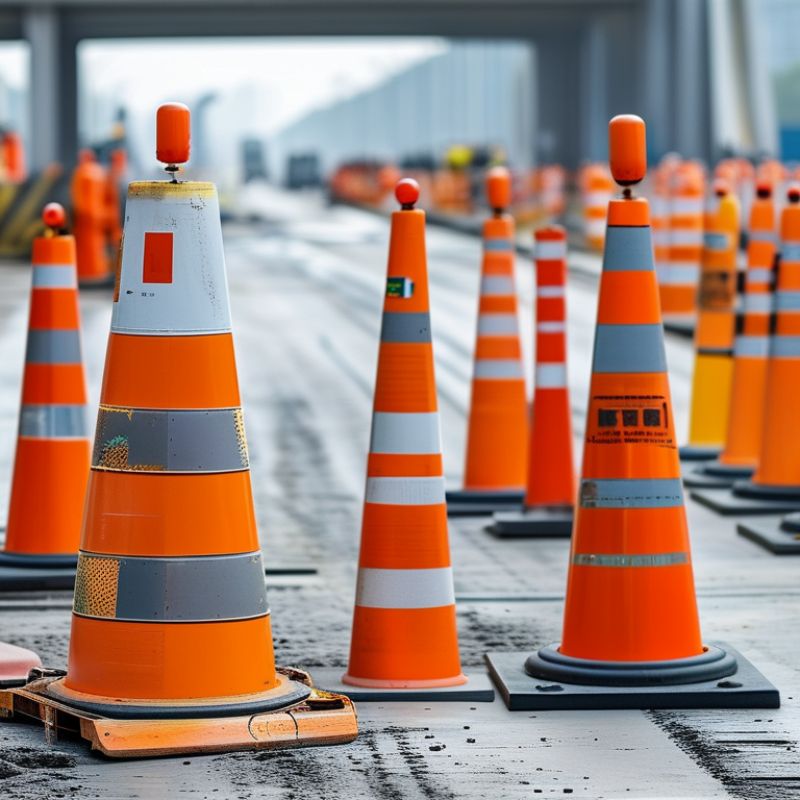
When choosing a traffic cone supplier, material and visibility deserve more attention than price. On busy road projects, I have found PVC cones feel heavier and resist sudden movement. PE cones are lighter and easier to transport. However, lightweight cones may need stronger bases in windy areas. Check the actual compound, temperature range, and base design.
Visibility changes after sunset. ASTM D4956 defines performance requirements for retroreflective sheeting, including different material types and performance levels. A supplier should identify the sheeting type and provide current test documentation. Do not accept “ASTM compliant” as enough evidence. Ask whether the reflective collar remains bright after abrasion, dirt exposure, and repeated handling. FHWA reported 891 work-zone fatalities in 2022, showing why nighttime recognition cannot be treated as decoration.
Look closely at the cone in daylight. Then inspect it under vehicle headlights from a distance. The collar should return a clear, even signal without peeling edges. PVC can provide useful flexibility, while PE may reduce carrying weight. Neither material is automatically superior. A poor formula, thin wall, or unstable base can defeat both. I once focused too heavily on color and overlooked collar adhesion. That was a costly lesson. Request production samples, dimensional records, and third-party test results before placing a large order. The supplier’s answers should match the physical sample, not only the sales sheet.
Validate Factory Quality: ISO 9001, AQL 1.5 Sampling, and Batch Traceability
Choosing a traffic cone supplier starts beyond the product photograph. A qualified factory should operate under ISO 9001, with documented procedures for purchasing, production, inspection, and corrective action. Ask to review the current certificate, issuing body, and covered production scope. An expired certificate proves very little. The factory should also control color consistency, cone height, base weight, flexibility, and reflective collar adhesion.
AQL 1.5 sampling provides a practical check for batch quality. It does not mean every cone is perfect. Inspectors select units according to a defined sampling plan, then record defects by severity. Critical defects may include unstable bases or sharp plastic edges. Major defects can involve incorrect dimensions or loose collars. Minor defects may include small surface marks. Request the inspection level, sample size, defect classification, and acceptance result. A factory that only says “passed inspection” is not being sufficiently transparent.
Batch traceability makes quality problems easier to investigate. Each shipment should connect to a production date, material lot, machine line, inspector, and test record. During factory visits, check whether operators can locate these records quickly. Ask them to trace one carton back to its resin supplier and production shift. I have found that tidy paperwork sometimes hides weak floor controls. Watch the real process. Calibration stickers, rejected cones, and segregated rework areas reveal more than a polished meeting room. Supplier selection should rely on records, physical checks, and honest answers about limits.
Test Safety Performance: Base Weight, Wind Stability, UV Aging, and Recovery
China Top Traffic Cones Supplier: How to Choose?
A dependable traffic cone supplier should show measured safety performance, not only bright product photos. Start with the base weight. A heavier base usually resists movement on exposed roads, but excessive weight may slow installation. Ask for the cone and base weights separately. Check whether the base sits flat on concrete, asphalt, and slightly uneven ground.
Wind stability needs practical testing. Place cones at set distances and record movement under controlled airflow. Observe tipping, sliding, and twisting, rather than checking only one result. A cone that survives briefly may still fail during repeated gusts. I have seen lightweight cones remain upright indoors but shift quickly beside open loading areas. That test was too comfortable. The method needed revision.
UV aging is equally important for outdoor use. Request test records showing color retention, brittleness, cracking, and reflective material performance after exposure. Compare aged samples with unused ones under the same light. Recovery testing should measure how quickly a cone returns after bending or vehicle contact. Check the collar, body, and base separately. Slow recovery can create a low warning profile. The result may look acceptable at room temperature but change in cold weather. Ask suppliers for temperature-based recovery data, production batch records, and clear sampling methods before making a purchase.
China Traffic Cone Supplier Selection: Safety Performance Test
Comparison of common traffic-cone specifications using base weight, wind stability, UV-aging retention, and recovery performance.
The reference dataset represents typical engineering test ranges for 70–90 cm flexible traffic cones. Wind stability is the minimum sustained wind speed before displacement, UV retention is the percentage of original color/physical performance retained after accelerated UV exposure, and recovery is the percentage of original height recovered after repeated compression. Actual results depend on cone geometry, material formulation, ballast design, and test conditions.
Compare China Suppliers: MOQ, Lead Time, Warranty, and 3-Year Cost
Choosing a China traffic cone supplier requires more than comparing unit prices. In field purchasing, I check material thickness, base stability, reflective sleeve quality, and production records. A low quote can hide weak packaging or inconsistent color. Request a sample before placing a large order. Then measure its height, weight, rebound, and sleeve adhesion. Keep the inspection report.
MOQ affects cash flow and storage pressure. A supplier offering 500 pieces may suit a small contractor, while a 5,000-piece MOQ can reduce the unit price. However, unused cones still occupy warehouse space. Ask whether mixed sizes or colors are allowed within one order. This detail often matters more than a small discount. Lead time also needs written confirmation. Include production days, inspection time, and sea or rail transit. Add a buffer for holiday shutdowns and port delays.
Warranty terms should state the coverage period, claim evidence, replacement process, and exclusions. Photos alone may not prove a manufacturing defect. A practical agreement defines acceptable fading, cracking, deformation, and missing parts. Calculate the three-year cost, not only the purchase price. Include freight, duties, inspection fees, damaged units, storage, replacements, and disposal. For example, a cheaper cone that fails after one winter may cost more than a stronger cone with a higher price. I once underestimated storage fees. That mistake changed the comparison. Supplier reliability should be tested through a small repeat order, not promises alone.
.png)