.png)
What Are the Different Types of Traffic Signs?
Roads communicate through color, shape, symbols, and placement. Traffic signs turn complex movements into quick visual decisions for drivers, cyclists, and pedestrians. Their purpose extends beyond directions. They regulate behavior, warn about hazards, and support safer road sharing.
The World Health Organization’s Global Status Report on Road Safety 2023 estimates that about 1.19 million people die in road crashes each year. Clear signs cannot prevent every collision. They can reduce uncertainty at intersections, work zones, sharp bends, and pedestrian crossings. The report also emphasizes safer road systems, where infrastructure supports human behavior rather than assuming perfect attention.
Most traffic signs fall into recognizable groups. Regulatory signs communicate legal controls, such as speed limits, stop requirements, and restricted movements. Warning signs highlight changing conditions, including falling rocks, merging lanes, or slippery surfaces. Guide and informational signs identify routes, destinations, services, and public facilities. Temporary signs manage construction zones and other short-term risks.
The Federal Highway Administration’s Manual on Uniform Traffic Control Devices, 11th Edition, provides detailed guidance for sign design, visibility, placement, and consistent meaning in the United States. International practice also reflects principles from the Vienna Convention on Road Signs and Signals. Yet standards differ between regions. A symbol familiar in one country may confuse visitors elsewhere.
Small details matter. A faded sign, blocked arrow, or poorly timed message can create hesitation. Real roads are less tidy than diagrams. This guide examines the main types of traffic signs, their visual signals, and the situations they are designed to clarify. Some classifications overlap, and that is worth remembering.
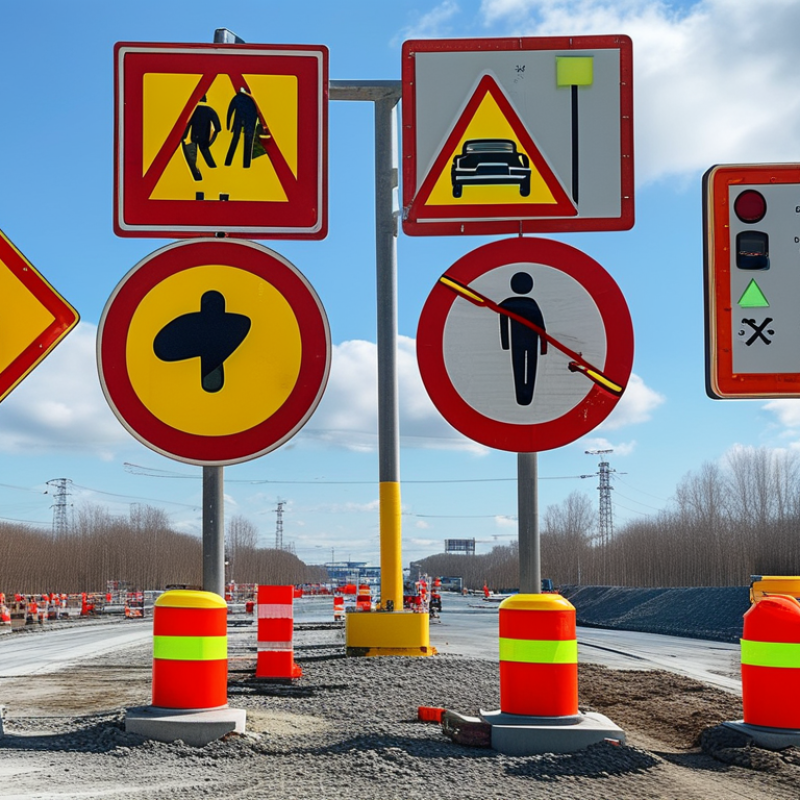
What Traffic Signs Are and Why They Matter
Traffic signs are visual instructions placed where drivers, cyclists, and pedestrians must make quick decisions. Their main types include regulatory signs, warning signs, guide signs, and temporary work-zone signs. Regulatory signs control behavior, such as speed limits or turning restrictions. Warning signs highlight hazards, including sharp bends, crossings, and falling rocks. Guide signs identify routes, destinations, and services.
Their purpose is larger than roadside decoration. Signs create shared expectations before a decision becomes urgent. The World Health Organization’s Global Status Report on Road Safety 2023 estimates that about 1.19 million people die in road crashes each year, while 20–50 million suffer nonfatal injuries. Clear signs cannot prevent every collision, but they can reduce uncertainty at junctions, crossings, and changing road layouts. That matters most when visibility drops or traffic becomes stressful.
Good signs depend on more than bright colors. The Manual on Uniform Traffic Control Devices stresses consistent symbols, legible lettering, proper placement, and adequate visibility. Retroreflective materials can return headlight illumination toward a driver at night. Small details matter. A sign hidden behind tree branches is technically present but practically useless. Even familiar signs can be missed when drivers travel too fast, feel distracted, or face confusing surroundings. That weakness deserves attention. Better sign systems require regular inspections, accurate spacing, and designs tested with real road users, not only engineers.
| Sign Category | Primary Purpose | Typical Shape | Common Colors | Examples | What Drivers Should Do | Why It Matters |
|---|---|---|---|---|---|---|
| Regulatory | Communicate traffic laws, restrictions, and required actions. | Circle, rectangle, or octagon | Red, white, black, or combinations of these colors | Stop, Yield, Speed Limit, No U-Turn, Do Not Enter, and One Way | Follow the instruction shown. Ignoring the sign may create a safety risk and may violate traffic law. | They establish predictable rules that help manage right-of-way, speed, direction, and road use. |
| Warning | Alert road users to hazards or changes in road conditions ahead. | Diamond | Usually yellow with black symbols or lettering | Curve Ahead, Intersection Ahead, Merging Traffic, Slippery When Wet, and Pedestrian Crossing | Reduce speed when appropriate, scan the roadway, and prepare for the hazard. | Advance notice gives drivers time to adjust speed, position, and attention before reaching a hazard. |
| Guide | Provide route information, destinations, distances, directions, and roadway identification. | Rectangle | Often green with white lettering; other colors may identify specific information | Route markers, destination signs, distance signs, street names, and exit signs | Read the sign early, confirm the destination, and choose the correct lane or route without sudden maneuvers. | They support navigation and help traffic move efficiently, especially at intersections and interchanges. |
| Temporary Traffic Control | Direct and protect road users through construction, maintenance, incidents, or other temporary conditions. | Diamond or rectangle | Typically orange with black symbols or lettering | Road Work Ahead, Lane Closed, Detour, Flagger Ahead, and Shift in Roadway | Follow the temporary route, obey reduced speeds, watch for workers, and respond to flaggers or other control devices. | They separate people and vehicles from changing hazards and communicate short-term route changes. |
| Service and Information | Identify nearby facilities and services that may help travelers. | Rectangle | Commonly blue with white symbols or lettering | Parking, hospital, telephone, fuel, food, lodging, and rest area | Use the information to locate a service safely; slow down and signal before leaving the roadway. | They help drivers find essential facilities without making unsafe stops or unexpected maneuvers. |
| School and Pedestrian | Mark areas where children, pedestrians, or other vulnerable road users may be present. | Pentagon or diamond | Fluorescent yellow-green, yellow, or white with contrasting symbols | School Zone, School Crossing, Pedestrian Crossing, and Playground Area | Slow down, yield where required, watch both sides of the road, and stop for pedestrians when required. | They draw attention to locations where a collision could cause serious harm to people outside vehicles. |
| Railroad Crossing | Warn road users that a railway crossing is approaching and reinforce crossing controls. | Round warning sign or crossbuck | Yellow and black for advance warning; white and red for some crossing controls | Railroad Advance Warning and Railroad Crossbuck | Slow down, look and listen for trains, obey signals and gates, and never drive around a lowered gate. | Trains need much more distance to stop than road vehicles, making early awareness essential. |
| Route and Highway Identification | Identify numbered roads and help travelers follow established routes. | Shield or rectangle | Varies by route classification; commonly uses contrasting white, black, blue, or red elements | Route number markers, interstate route markers, and highway reassurance signs | Use route numbers to confirm direction and remain on the intended road. | Consistent route identification improves orientation and reduces last-minute lane changes. |
| Lane-Use and Control | Control how individual lanes may be used and indicate turning or movement requirements. | Rectangle | White, black, red, or green depending on the instruction | Turn Only, Left Turn Permitted, Reversible Lane, HOV Lane, and Keep Right | Choose the correct lane early and follow the permitted movement shown by the sign and pavement markings. | They organize traffic movements and reduce conflicts between vehicles traveling in different directions. |
Related Posts
-
What Are the Most Important Road Signs for Safe Driving?
-
2026 Top Road Signs for Global Buyers to Consider
-
What is the Importance of Traffic Safety Signs for Drivers?
-
What are the Different Types of Road Traffic Signs?
-
10 Best Traffic Signs to Enhance Road Safety and Navigation?
-
Why Are Stop Signs Crucial for Road Safety Worldwide?